Three weeks on the market, and the offer finally comes in. It’s close to asking — but the buyer wants $10,000 toward closing costs. I’ve watched sellers read that line and go straight to insulted, like someone just reached into their pocket.
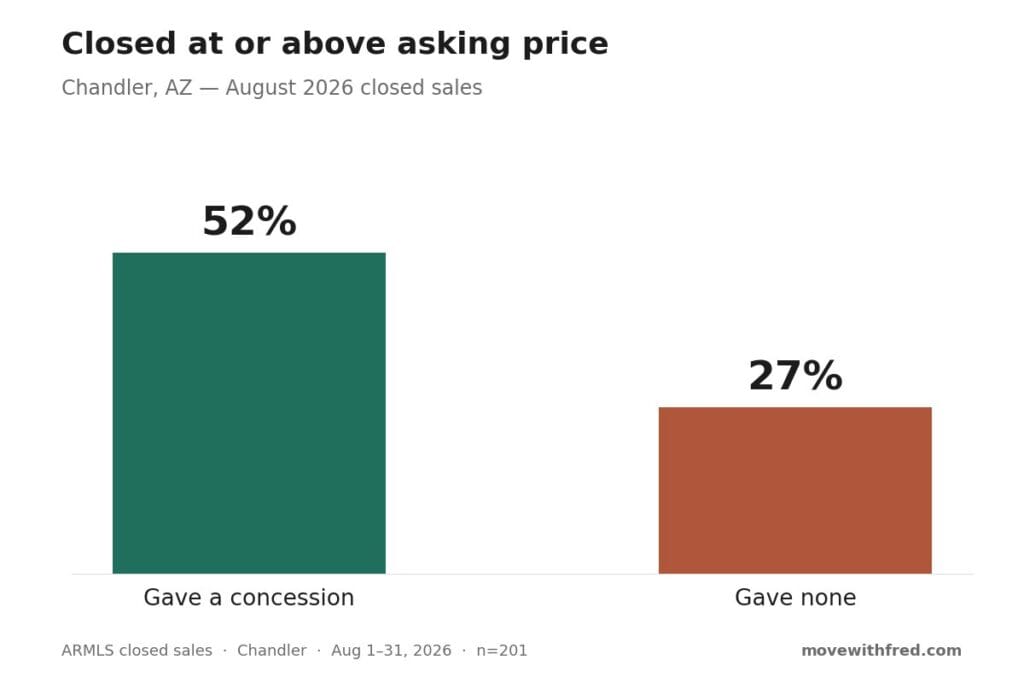
So I pulled every closed sale in Chandler for August and ran the numbers. The sellers who agreed to a concession were nearly twice as likely to close at or above their asking price as the ones who didn’t.
Concessions are the Chandler norm, not a lowball tactic
Here’s what I’m working from: 210 closed sales in Chandler proper, August 1 through 31, 2026, across 85224, 85225, 85226, 85248, 85249, and 85286. I pulled it out of ARMLS myself on September 7 and cut Sun Lakes out of it — that’s a 55+, cash-heavy market and it doesn’t tell you anything useful about a Chandler resale.
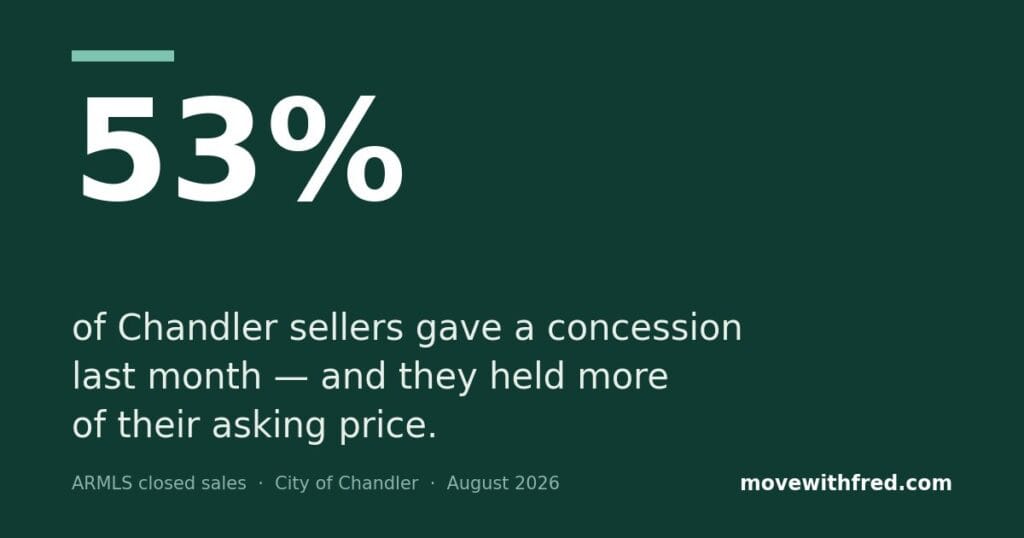
Of those 210, 201 reported the seller concession field. 107 of them — 53% — included one. (Nine closings didn’t report the field either way, so that 53% is out of the 201 that did.)
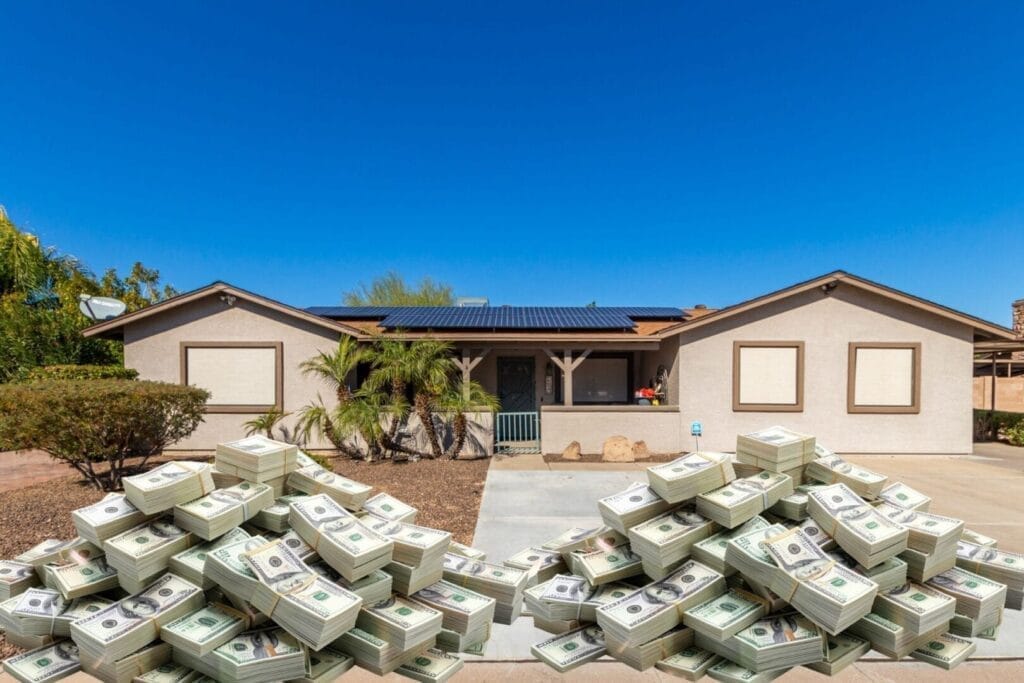
Median concession: $9,900, or right at 2% of the sale price. Upper quartile was $12,180. The largest was $28,000. And half the sellers who gave a concession gave $10,000 or more.
So when a buyer asks a Chandler seller for ten grand toward closing costs, they’re not testing you. They’re asking for the number roughly half your neighbors already said yes to last month.
The sellers who gave concessions did better
I split the 201 reporting closings into two groups — gave a concession, gave none — expecting the concession group to look worse on price. That’s the whole assumption behind the flinch.
| August 2026, Chandler | Gave a concession | Gave none |
|---|---|---|
| Closed at or above list price | 52% | 27% |
| Share of original list received | 98.2% | 95.8% |
| Median sale price | $510,000 | $502,500 |
| Took a price cut first | 38% | 47% |
| Median days on market | 45 | 45 |
Same time on market. Slightly higher median price. And nearly double the rate of closing at or above asking.
The honest version of that finding
I’m not claiming the concession caused any of it, and there’s one wrinkle I’d rather show you than bury. The no-concession group contains more sellers who had already cut their price — 47% versus 38%. Price cutters keep less of their original list almost by definition, so part of that 98.2-versus-95.8 gap is who’s in each group, not what they did.
So I split it again, by whether the seller had cut the price. Among sellers who never cut, the gap is narrower — 56% versus 44%. Among sellers who had already reduced, it isn’t close.
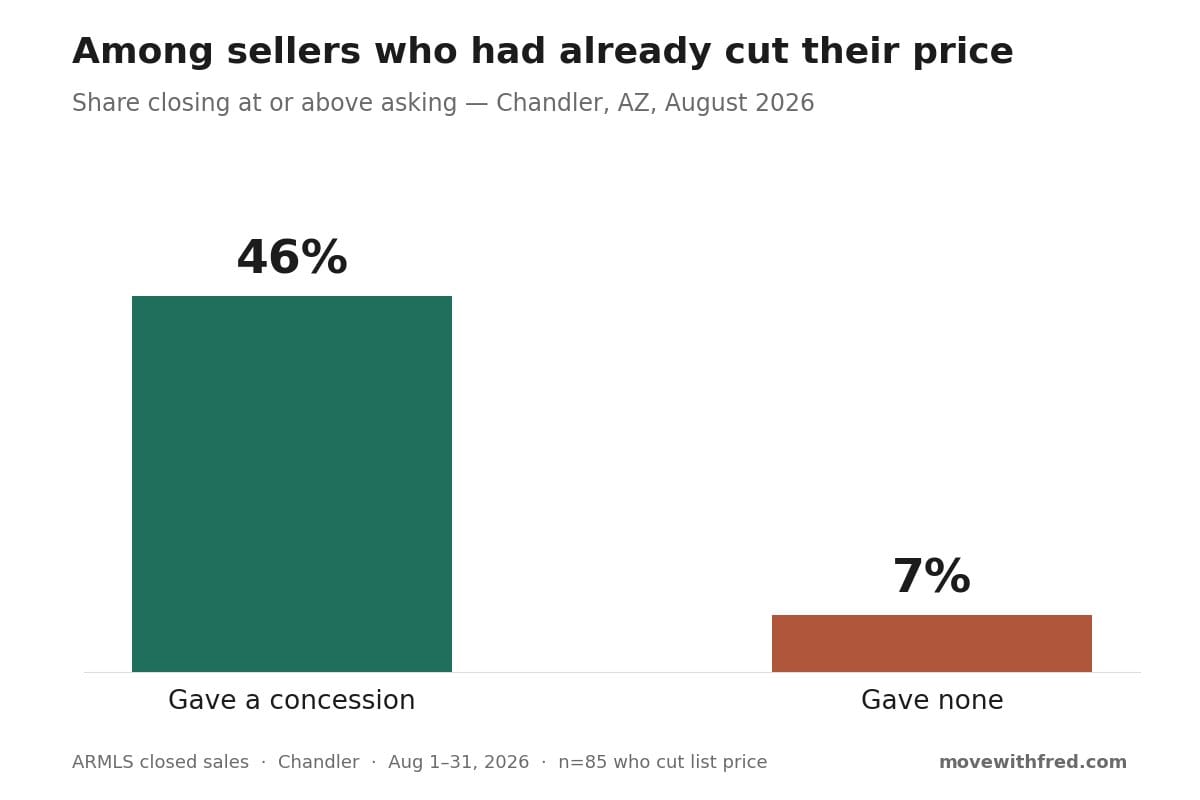
Both groups landed at exactly 92.4% of original list — dead even. But the ones who worked in a concession closed at or above their reduced asking price 46% of the time. The ones who refused: 7%.
That’s the number I’d hang my hat on. Once a Chandler seller has cut the price, refusing the concession too is where deals go to sit.
Why a dollar of concession buys more than a dollar off the price
The mechanism isn’t mysterious from the buyer’s side of the table.
A financed buyer is usually up against two separate walls: a monthly payment they can live with, and a pile of savings that has to cover down payment plus closing costs. Those aren’t the same wall. Knock $10,000 off a $506,000 price and you move the monthly payment a little — real, but not what’s blocking the deal. Hand that same $10,000 over at closing and it covers prepaids, funds the escrow account, or buys the rate down. It lands on the constraint that’s actually binding.
Same money, aimed at the part that hurts. That’s why it buys more agreement per dollar.
The price cut is also the more expensive move in ways that never show up on your settlement statement. A price cut is permanent and public. It sits in your price history on every portal a buyer looks at, and it tells the next person through the door that your number was soft — so they start below the new one. It becomes a comp for the neighbor who lists in November and for the appraiser on your own deal. A concession is one line on one settlement statement. The recorded sale price is still the sale price.
What this looks like by ZIP
Concession rates aren’t uniform across Chandler, and the spread is wide enough to change how you plan.
| ZIP | Closings | Median price | Median DOM | % with concession |
|---|---|---|---|---|
| 85224 | 35 | $435,000 | 51 | 65% |
| 85225 | 44 | $474,500 | 38 | 55% |
| 85226 | 25 | $507,000 | 41 | 44% |
| 85248 | 17 | $580,000 | 51 | 35% |
| 85249 | 43 | $665,000 | 48 | 51% |
| 85286 | 46 | $567,000 | 45 | 57% |
If you’re in 85224 — Knoell East, College Park, Silvergate, the older core west of Alma School — two of every three closings around you included a concession. Plan on it. In 85226 it’s under half.
The 85248 row is the Chandler side only: Ocotillo, Fulton Ranch, Fox Crossing, Oakwood Lakes. Lowest concession rate in the city at 35%, though at 17 closings I’d treat that as directional rather than settled. And price tier doesn’t drive this the way you’d expect — 85249 has the highest median in Chandler at $665,000 and still ran 51%.
How to budget for it before you list
Put 2% of your expected sale price in the column as a cost of sale. Not a loss — a line item, same as title fees. If your Chandler home should sell around $506,000, that’s roughly $10,000 penciled in from day one.
Decide before you list, not at 9 p.m. with an offer in front of you. The sellers who react badly are almost always the ones seeing the possibility for the first time. Know your number and your walk-away in advance and it stops being emotional.
Know your ZIP’s rate. A seller in 85224 and a seller in 85226 shouldn’t plan the same way.
Don’t reach for the price cut instead. In August, 43% of Chandler sellers took at least one reduction and 60% still closed below list. Median days on market was 45, with 620 active listings against 210 closings — right around 2.9 months of supply. That’s a market where buyers have room to ask, and where a cut often doesn’t buy the speed sellers are hoping for.
One thing to confirm early: FHA, VA, and conventional loans cap seller contributions at different levels, and the buyer’s lender sets the actual ceiling — sometimes below what the buyer asked for. Find out what their loan allows before you agree to a number, so you’re not renegotiating twice. If a structure starts getting creative, that’s a conversation for a real estate attorney, not for me or your lender.
So what do you do with the next $10,000 request?
None of this means you hand it over on sight. It means the ask shouldn’t blindside you, and it shouldn’t blow up an otherwise solid offer over pride. In Chandler right now, a concession request is what a serious buyer looks like.
Curious what your place would actually sell for, before anybody asks you for a concession on it? I run free, no-pressure home valuations — no obligation, no drip campaign. Check what your Chandler home is worth.
Data source: ARMLS closed sales, City of Chandler, August 1–31, 2026 (210 closings across 85224, 85225, 85226, 85248, 85249, 85286), pulled September 7, 2026. Sun Lakes addresses excluded. Concession figures reflect the 201 closings that reported the seller concession field. Correlation only — no causal claim is made or implied.